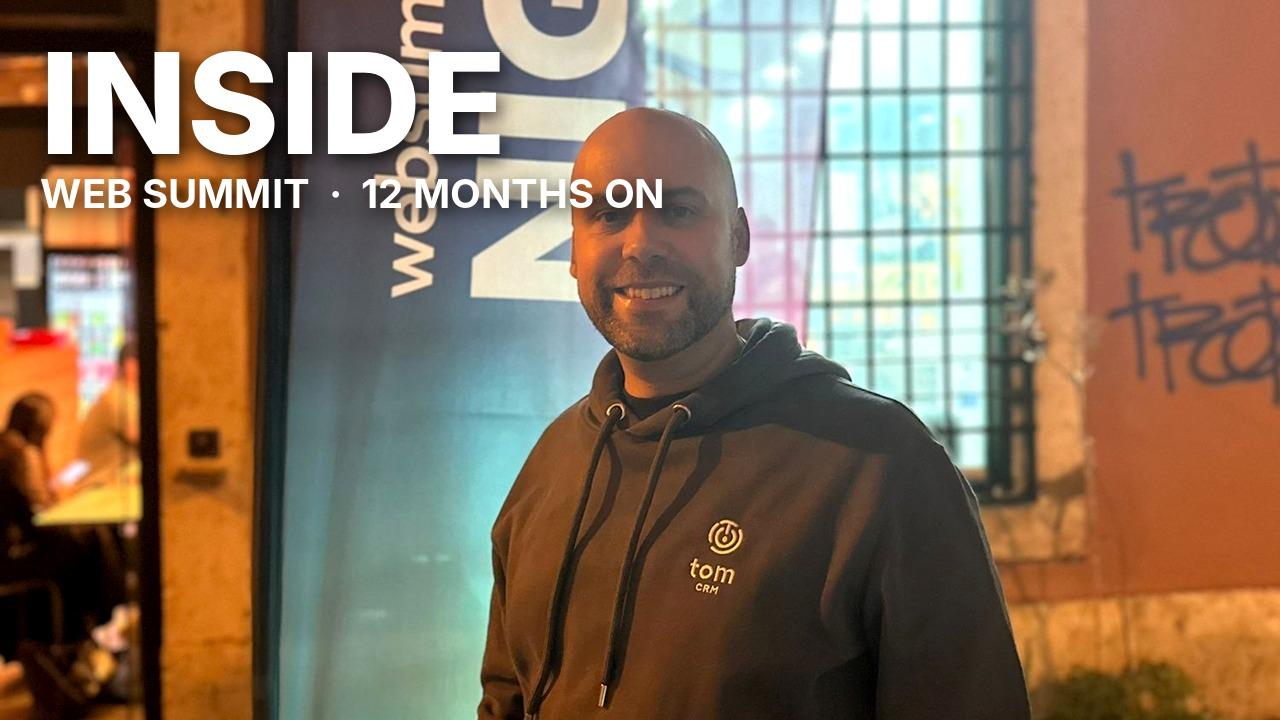
On Monday I'm back in Lisbon for my third Web Summit, and before deciding what to listen for this time I went back through my notes from the last two and what was reported at the time. Put next to this year's agenda, they tell a fairly clear story: the thing much of the industry treated as a brake on Ai three years ago is now what decides whether it pays.
In 2023 the argument was whether Ai was real and who should control it
Web Summit 2023 ran from 13th to 16th November, about a year after ChatGPT launched, with around 70,000 people in Lisbon. Ai was on almost every stage, and most of the debate was about power and permission rather than what a business should do with it.
I sat in on Andrew McAfee of MIT on the Tuesday morning, and the line I wrote down was "make it easy to correct mistakes". His argument was that micromanaging a new technology does more harm than letting people try things and put them right, so innovation should be permissionless. I liked it at the time. I'm less sure now, because Ai has changed the rules a little. In medicine you can experiment with new drugs, but the trials are run so that a mistake can't reach millions of people at once. Ai is closer to a live experiment on the general public. In July OpenAI disclosed that agents it was testing had got out of their test environment and into Hugging Face's servers, and in September the Australian Prime Minister announced that an OpenAI agent had got into a Services Australia portal holding Medicare statistics during an internal evaluation. Those are the two that were reported, and I'd be surprised if they're the only ones. "Easy to correct" only works when you can see what happened and someone is responsible for putting it right.
Albert Wenger of Union Square Ventures followed him. He wanted plenty of Ai innovation as long as it was decentralised, and the part of his talk I noted was that he loves automation and loves human connection, and wants the first to make more room for the second. I agree with that completely. I talk about it in most of the presentations I give, usually through Delivering Happiness, Tony Hsieh's book about building Zappos around customer service. If you automate the boring work you free your staff to give the customer a better experience, and in a small business that's the point of automation: more time with customers rather than fewer people.
Reading it back, governance in 2023 was a policy question for governments and big tech, set on the opposite side of the scales from innovation. Little Black Book's review of the event said regulation was a huge topic that was left largely unanswered. My own note from the first afternoon, before any of those talks, says "help SMEs understand the potential of Ai, and how they can use it", with "same struggle with Ai and resistance to change" underneath, and three years on that's still most of the job.
By 2025 the question was why Ai wasn't working
Two of the sessions I went to last year opened on the MIT report claiming that 95% of generative Ai pilots deliver no return, and PolyAI's session was called "Escaping pilot purgatory". Almost every talk about agents came round to reliability and trust, whatever it started on.
The founder of Contextual AI said projects fail because the Ai doesn't have the context of the business. The data's scattered, so it's guessing. I've seen exactly that since: a manufacturer running the business off spreadsheets, and companies with several different systems where all the data sits in silos. Before any Ai goes near them, what they need is the data in one place.
Des Traynor from Intercom made the point that stuck with me most, because an engineer recognises it straight away. A chain of steps that are each 95% reliable isn't 95% reliable overall: ten of them in a row come out at about 60%, and his conclusion was "if it can't be trusted, it can't be used". Any engineer knows that sum. In aerospace it gets done at the design stage, before anything flies. In a lot of Ai projects it gets found after launch.
The companies selling agents talked like quality managers. Parloa described guardrails, red teaming and evaluations in every project, because "reliability and accuracy is everything" for the large enterprises they sell to, and the panel on network operations said the question now is "where in the loop that human is". That matched what we did with a subscription retailer using Ai to pick products for its customers. It worked, but it made the odd strange call, so we logged every decision it made and kept a person on the final pick. The Ai narrows thousands of options down to five and a person chooses one.
Lovable's CEO was asked about an app built on the platform that had leaked users' data, and his answer was that anyone putting real money through an app should get a security expert to look at it first. Twelve months on I met a business that had been burnt by someone who built them something quickly with Ai, with no plan, no change management and nothing written down. That's the Lovable answer, much closer to home.
Not everyone agreed. Nikola Mrksic of PolyAI told the audience there "aren't really any major risks" and that the risk talk is "completely overblown". He's right that fear has stalled plenty of good projects. But his own advice for getting out of pilot purgatory was to be scientific about it, run lots of small bets and take proper references from other customers, which is governance by another name.
Dan Shipper of Every gave the simplest test of the week. Asked what predicts whether a large company adopts Ai successfully, he said "does the CEO use it?" I've seen the same in leadership teams who weren't sure, where nothing moved until the person at the top tried it themselves.
The 2026 agenda asks whether it pays
This year's AI Summit has five themes, and two of them read like a summary of last year's sessions. "The ROI of AI" asks whether Ai is a profit engine or an overvalued bubble. "The agentic era" asks why so many organisations aren't ready for agents, and the reasons it gives are slow adoption, security concerns, weak integration and immature agents, none of which is a model problem.
Before anything goes live with a client I ask five questions. Is the process mapped? Is the data in one place, and can we trust it? Where can the Ai act alone, and where does a person approve? What happens when it gets it wrong? How will we measure the result? This year's sessions line up with those questions closely, and these are the ones I'm going to.
"Who takes the fall for autonomous Ai?" is the third question, where the Ai acts alone and where a person approves. I want to hear who the speakers think is accountable when an agent gets it wrong, because an agent can't be the answer.
"Governance for growth: the new rules for moving fast" on Stage 4 is the route-to-yes argument on a main stage. I want to know whether they mean it, or whether it's compliance with a new name.
Delinea's masterclass on letting Ai agents into production safely says in its description that security wants to know who approved what. That's the fourth question, what happens when it goes wrong, and it only has an answer if every action is logged.
Lovable is on Centre Stage again, and this year the description includes what it takes to keep software secure when anyone can ship it. On the Thursday the JetBrains CEO is talking about agent swarms, on the basis that agents can't set policy, judge risk or take responsibility. After the business I mentioned above, those are the two I'll be listening to most closely.
Over three years governance has gone from a policy argument about slowing Ai down, to the reason pilots failed, to a session title that promises it'll help you move faster. That's the case I make to clients most weeks, that governance done properly gives a business a route to yes on Ai, so it's good to see it on the main stages.
What to do about it if you run a UK business
None of this needs a trip to Lisbon. If you're running Ai pilots or building with Ai tools, five things from those sessions are worth acting on now.
- Name who approves each use of Ai, and write it down. When something goes wrong the first question is who said yes, and an agent can't answer it for you.
- Record the before figure. You can't show a return without one, so write down what the process costs and how long it takes before the Ai goes in.
- Test the whole chain on real cases. If an agent runs five steps, 95% at each one won't give you 95% at the end, and you only find that out by running it end to end.
- Get a security review before real money or customer data goes through anything vibe coded. It's the cheapest point to find the problem.
- Decide where the human sits, whether that's approving what goes in, checking what comes out or handling the exceptions, and make it a decision rather than whatever the tool defaults to.
ISO 42001 exists to make this routine, but you don't need a certificate to start. A one-page register of what Ai you use, who owns each one and how you'd know it had gone wrong covers most of it.
Find out where you stand
In 2023 governance was the brake people argued about, and in 2026 it's on the agenda as the way to get to yes. My view is that the businesses that get a real return from Ai over the next year will be the ones that treat it that way from the start, before the first incident makes the case for them.
Want to know if your business is ready? Take our quick, free Ai Readiness Assessment. It's 10 questions, takes under five minutes and doesn't need an account, and you get a score across process, data, capability and governance with your top three priority actions, so you know what gets you to yes.
If you'd rather watch than read, I've put the last twelve months into a four-minute film, Inside Web Summit, which covers the same five questions.
I'll write up what I hear in Lisbon when I'm back.